IBD flare prediction
your patients share with you
Patients arrive with up to 60 days of objective and symptom data, scored with validated HBI and SCCAI. You start the appointment informed.


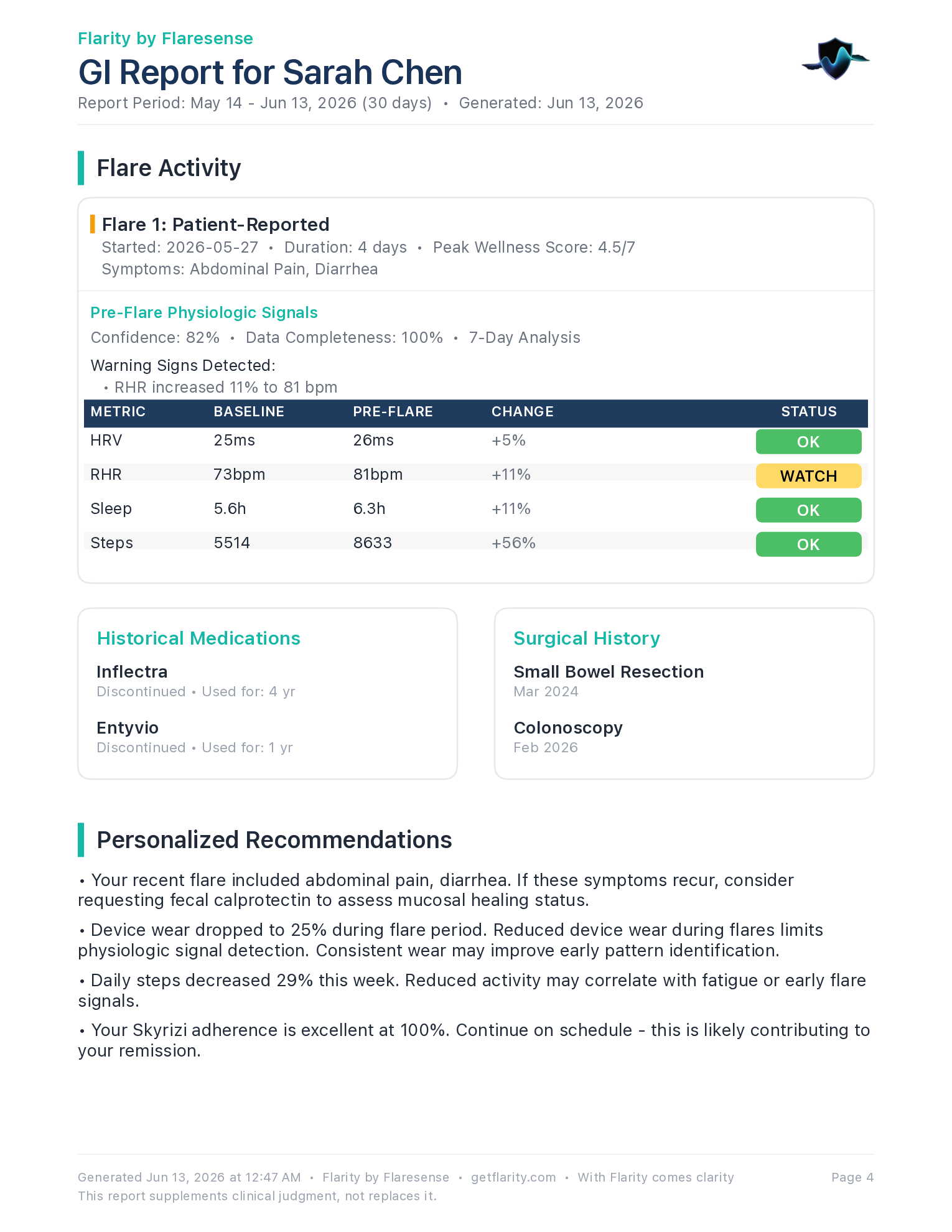
The Gap Between Visits
IBD doesn't pause between appointments. But patient recall does.
Patients forget symptoms. Flares are reported after the fact. The first 10 minutes of every visit is spent reconstructing what happened.
Paper diaries are incomplete. Portal questionnaires have low compliance. You're making decisions with incomplete data.
What if patients arrived with up to 60 days of continuous data: objective vitals and validated symptom scores, ready to go?
What You Receive
Patients generate comprehensive PDF reports in 30 seconds. No training required.
Clinical Summary
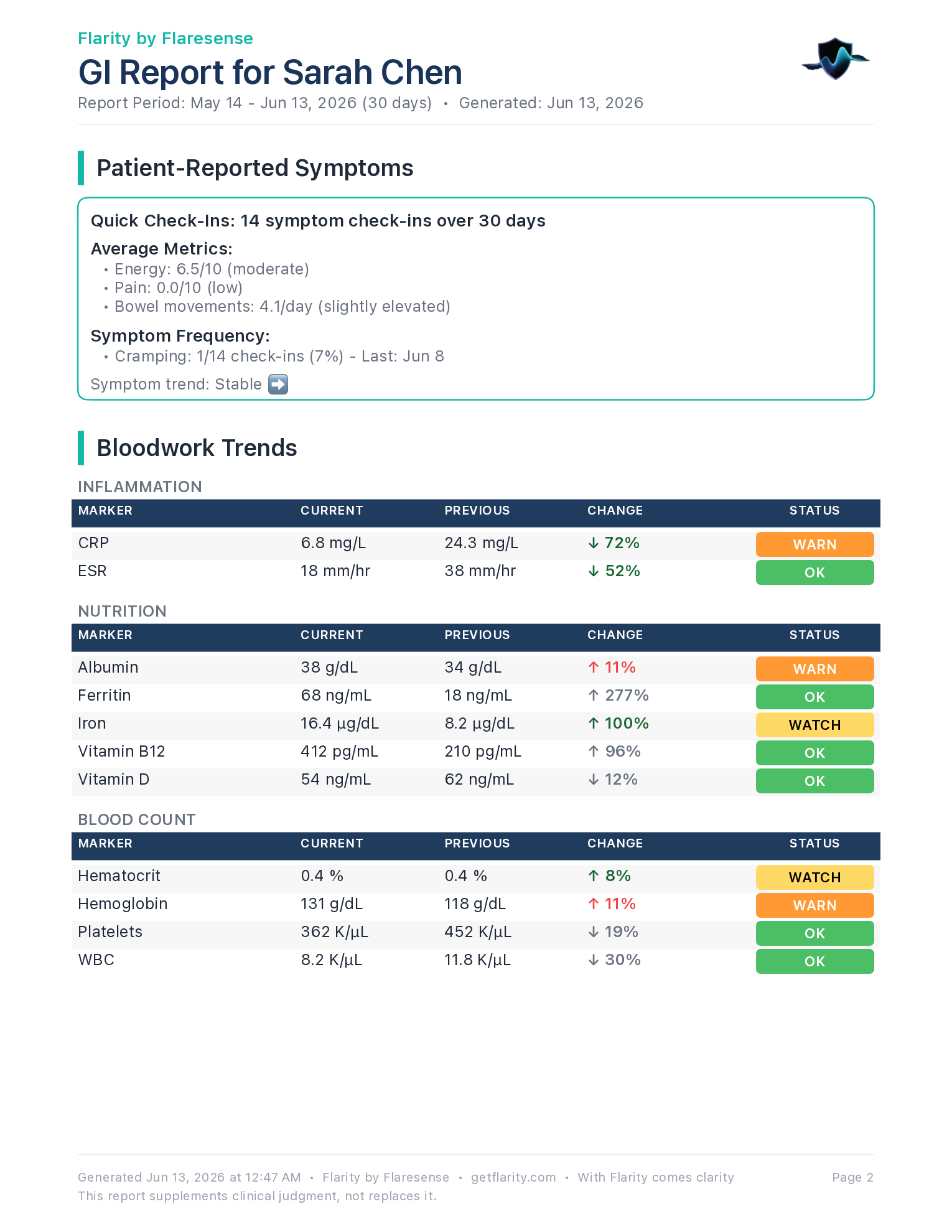
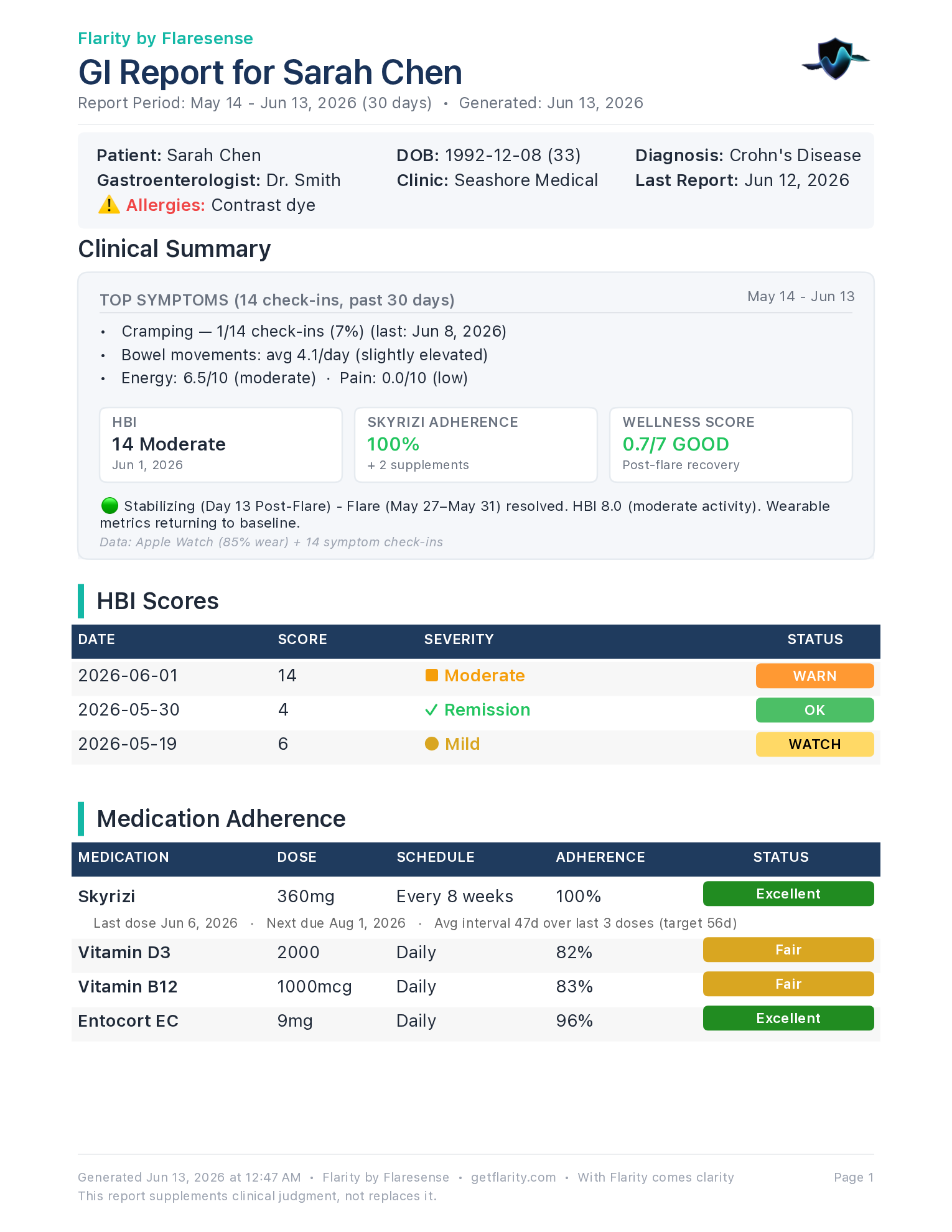
Wellness score (0–7), current HBI/SCCAI, medication adherence, and top symptoms with a one-line disease-activity trajectory.
Bloodwork Trends
CRP, ESR, albumin, CBC, iron studies, and liver/kidney panels. Current vs. previous, with directional change and status flags.
Wearable Health Trends
HRV, resting heart rate, sleep duration and efficiency, wrist temperature, and activity. Personal baseline vs. 7-day average.
Flare Activity & Pre-Flare Signals
Each flare's duration, peak severity, and symptoms, plus the pre-flare physiologic changes detected, with confidence and data completeness.
Medication Adherence
Adherence by medication with dosing intervals (e.g. biologic timing vs. target) and pattern detection for missed doses.
HBI/SCCAI Scores
Validated clinical indices tracked over time with remission/active thresholds.
Questions for You
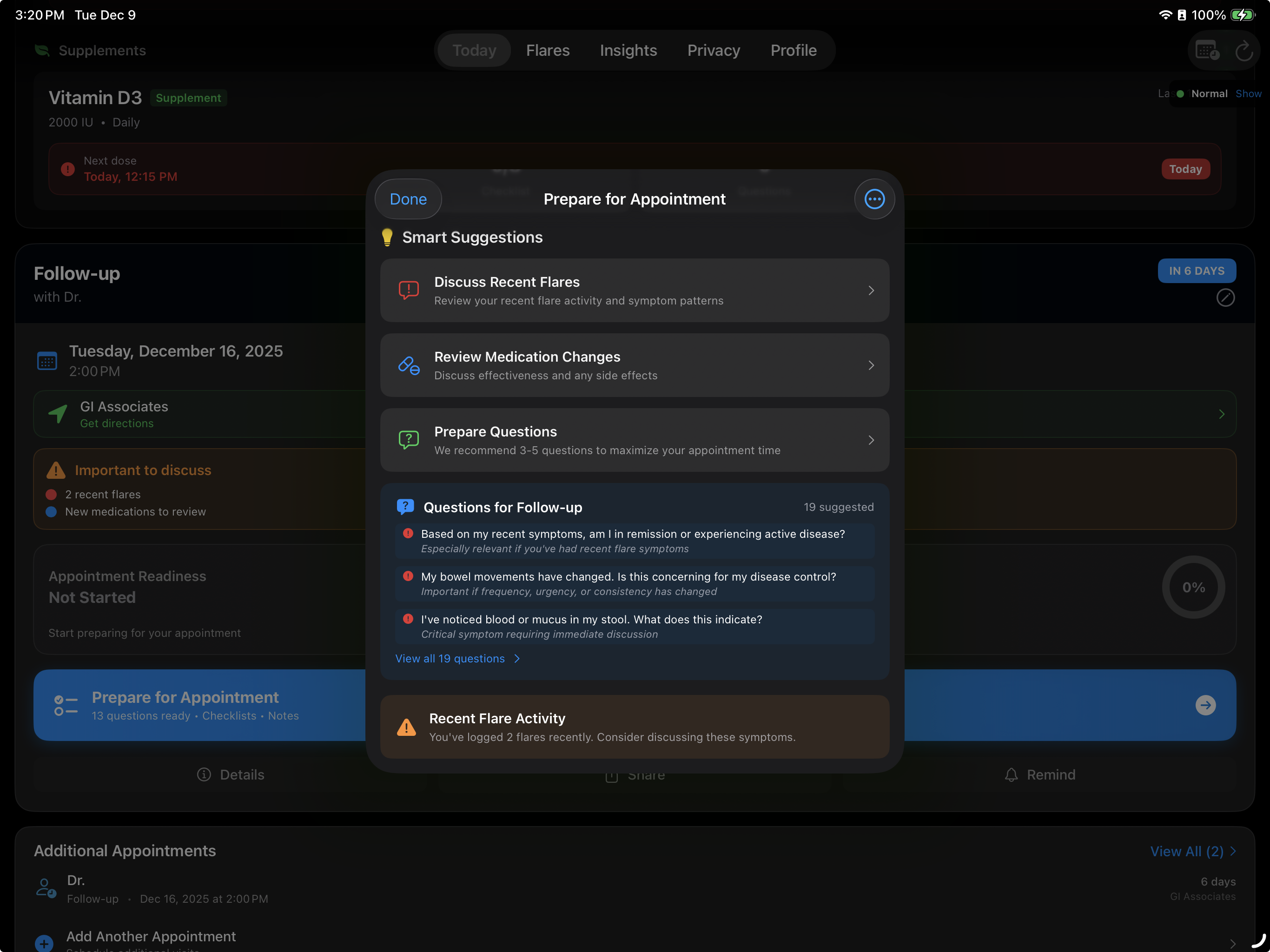
The patient's saved questions plus data-driven prompts (e.g. biologic timing vs. flare onset) to focus the conversation.
Personalized Recommendations
Plain-language suggestions surfaced from the patient's own data, framed to supplement your judgment, not replace it.
How It Works
Flarity combines objective wearable data with subjective symptom input. The same methodology you use, now continuous.
Wearable Layer
Apple Watch monitors HRV, heart rate, sleep, temperature, activity, and SpO2. Deviations from personal baseline trigger symptom prompts.
Symptom Layer
Brief check-ins based on HBI (Crohn's) or SCCAI (UC). 30 seconds, only when needed. No survey fatigue.
Combined Score
Wearables alone can't assess pain. Symptoms alone rely on memory. Combined assessment gives the complete picture.
No Portal. No Logins. No Burden.
Flarity requires nothing from your practice.
Patients share reports via email, AirDrop or Quick Share, or upload to your existing portal
Clinically formatted data using HBI, SCCAI, and Montreal Classification
Works alongside your current EHR workflow
EHR integration (FHIR, Epic MyChart) on our roadmap. Contact us for early access.
Built on Peer-Reviewed Science
"Wearable devices can detect and predict IBD flares through changes in heart rate variability and resting heart rate, often days before symptoms appear."
Flarity was created by a founder living with Crohn's disease. Someone who's been through the ER visits, the scope preps, the uncertainty between appointments.
After an ileocecal resection in 2024, he built the tool he wished existed: continuous monitoring that speaks his gastroenterologist's language. With 15 years of B2B SaaS leadership and deep experience in GRC and compliance, the founder brings both the patient perspective and the enterprise expertise needed to build a clinically-credible, privacy-first solution.
Flaresense Inc. | Toronto, Canada
Easy for Patients. Valuable for You.
Free on iOS and Android. Works with or without a wearable.
Wearables sync via Apple Health (iOS) or Health Connect (Android). Apple Watch provides the richest data with real-time monitoring.
What Patients See Before Their Visit
Patients arrive prepared with auto-generated reports and discussion points, reducing time spent on history taking
One-Tap Report Generation
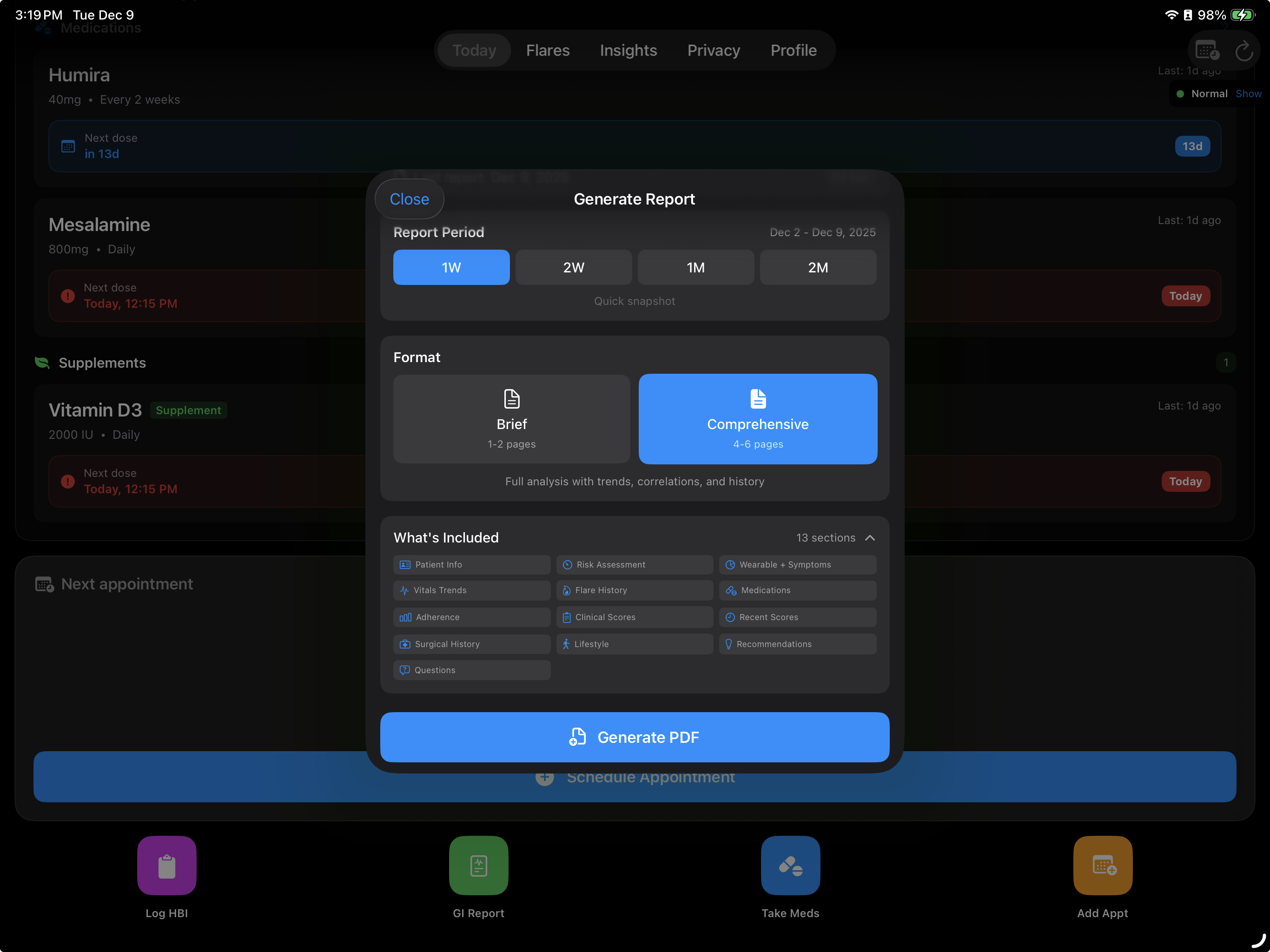
Patients choose the period and format, brief or comprehensive, and toggle bloodwork trends, a provider page, and suggested questions. A clinically formatted PDF across 15 sections, in about 30 seconds.
Suggested Discussion Points
Patients receive data-driven questions based on recent symptoms, flares, and medication changes, so visits focus on what matters.
Procedure prep, digitized
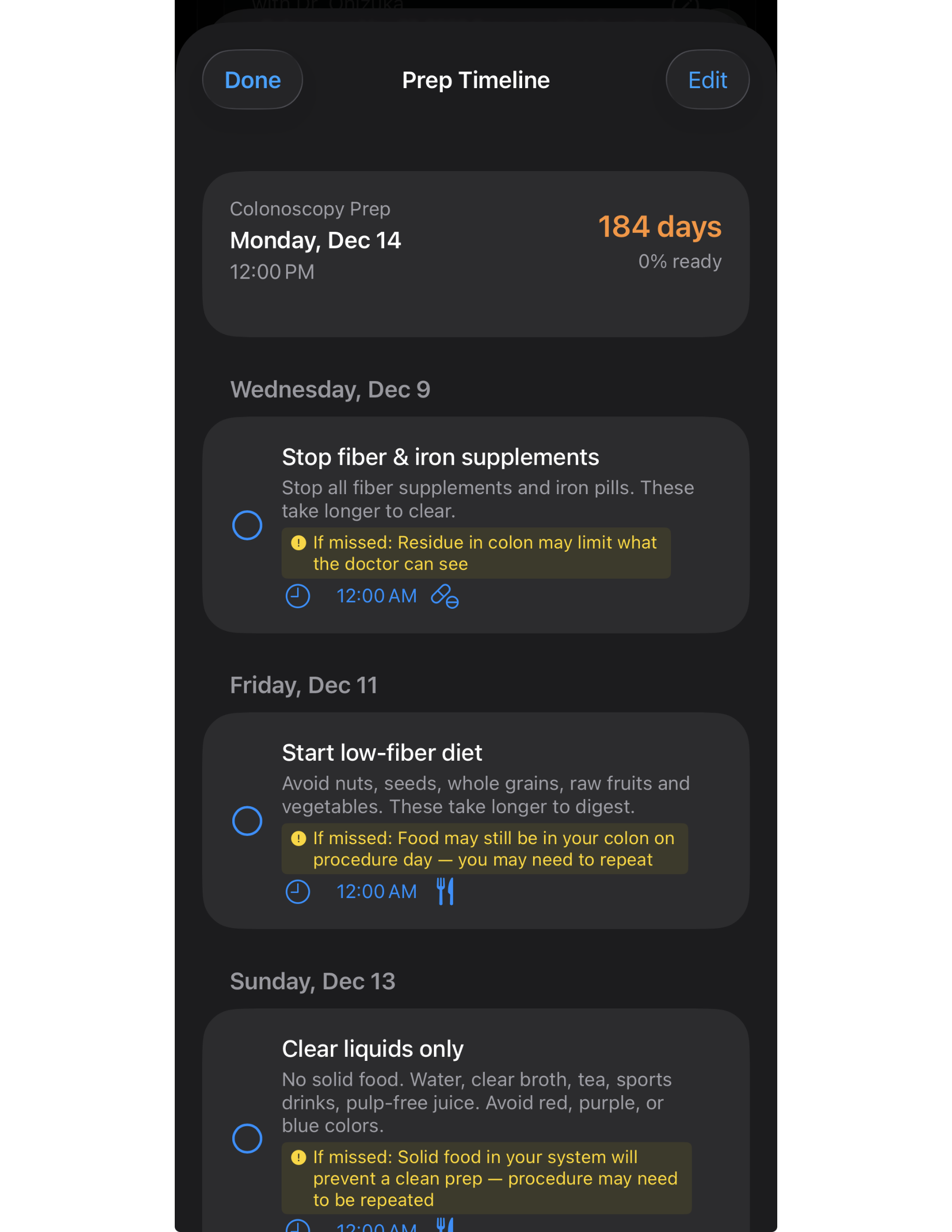
Incomplete bowel prep is a leading cause of aborted and rescheduled colonoscopies. Flarity converts your prep instructions into a timed checklist with reminders, so patients follow every step in the right order and arrive ready.
- Your instructions, converted to a day-by-day timeline
- Timed reminders for diet changes and split-dose prep
- Plain-language stakes on every step, so nothing critical is skipped
Critical Context, Even Away From You
Your patients carry two privacy-first cards in Apple Wallet and Google Wallet, so the essentials travel with them to the ER or urgent care. Self-reported, stored on-device, never sent to Flarity.
 Urgent AccessFLARITY
I need urgent access to a restroom
I have a medical condition that gives me little or no warning. Thank you for your understanding.
A communication aid for self-advocacy. Not a government document, and it does not guarantee entry.
Self-reported · stays on the patient's device and private iCloud · never sent to Flarity.
Why now
Wearable ownership is mainstream, and 2025 brought the first large IBD validation from Mount Sinai in Gastroenterology. Flarity pairs that signal with validated HBI and SCCAI scoring. Built by a founder living with Crohn's and 15 years in B2B SaaS, GRC, and compliance. Privacy first, processed on device.
Common Questions
Patients generate PDF reports in the app with one tap. They can share via email, AirDrop or Quick Share, or upload to your patient portal. No integration required on your end.
Flarity is available free on iOS (App Store) and Android (Google Play). For wearables, it works with Apple Watch (best experience), Oura Ring, Whoop, Garmin, and Fitbit, via Apple Health on iOS or Health Connect on Android. Patients without a wearable can still use phone-only mode with symptom tracking and basic activity data.
Harvey-Bradshaw Index (HBI) for Crohn's disease, Simple Clinical Colitis Activity Index (SCCAI) for ulcerative colitis, and Montreal Classification for disease location/behavior. The same validated tools you use.
Flarity is a wellness application, not an FDA-cleared medical device. It's designed to support patient self-tracking and clinician communication, not to diagnose or treat.
Not yet, but EHR integration (FHIR, Epic MyChart) is on our roadmap. Currently, patients share reports directly with you. Interested in early integration access? Contact us.
Patients can try Flarity free for 21 days. After that, plans are $14.99/month or $149/year. There's no cost to you or your practice.
The 2025 Mount Sinai study detected flare signals up to 7 weeks early under research conditions. Flarity conservatively targets up to 4 weeks advance warning to account for real-world variability and ensure clinically actionable accuracy. Prediction improves as the app learns each patient's personal baseline over time.
Get in Touch
Questions about Flarity? Interested in a pilot program or EHR integration?
Or email us directly:
support@getflarity.ai